The Moon Passes in Front of Jupiter on the Eighth, and Kuwait Will Not See It
But that dawn brings the crescent, the planet and the Beehive cluster into one view, from six minutes past three.
On Tuesday 8 September the moon passes in front of Jupiter and hides it — what astronomers call a lunar occultation. It will not be seen from Kuwait.
Why not from here
The moon is close enough to Earth that its position in the sky shifts depending on where you stand, by as much as two degrees between one side of the planet and the other. So the hiding is complete in one place and a near miss in another.
The occultation on the eighth is visible from Canada, Greenland, eastern Russia, the continental United States and elsewhere. From Kuwait it is an approach, not a hiding.
What we see, and at what hour
Dawn on Tuesday the eighth. The moon and Jupiter are forty-six arcminutes apart, about a moon and a half.
- They rise at 3:06 in the morning, two hours and twenty minutes before the sun.
- They reach twenty-five degrees above the eastern horizon.
- They fade into the light of dawn around 5:11.
The moon is twenty-seven days old that morning — a thin waning crescent — and Jupiter is very bright and unmistakable. Both are in Cancer.
And a third guest in the same view
At the same dawn the moon approaches the Beehive cluster, an open star cluster in Cancer known to astronomers as M44. The gap between them is forty-two arcminutes, closer than Jupiter. It rises before them, around 2:29.
The cluster is far fainter than Jupiter and needs a sky away from city lights to be seen with the eye. Through binoculars it appears as a handful of small stars side by side.
And two dawns earlier
On Sunday 6 September the moon passes three degrees north of Mars, both in Gemini. From Kuwait they rise at 1:01 after midnight and climb to forty-seven degrees.
Mars is far from Earth at the moment and faint — fainter than many ordinary stars. Anyone assuming the “red planet” will be the brightest thing in the view will be looking a long time: the bright one is Jupiter, two days later.
What to look with
The separations here are wider than a telescope eyepiece can hold in one field. Binoculars beat a telescope, and the naked eye is enough for the moon and Jupiter.
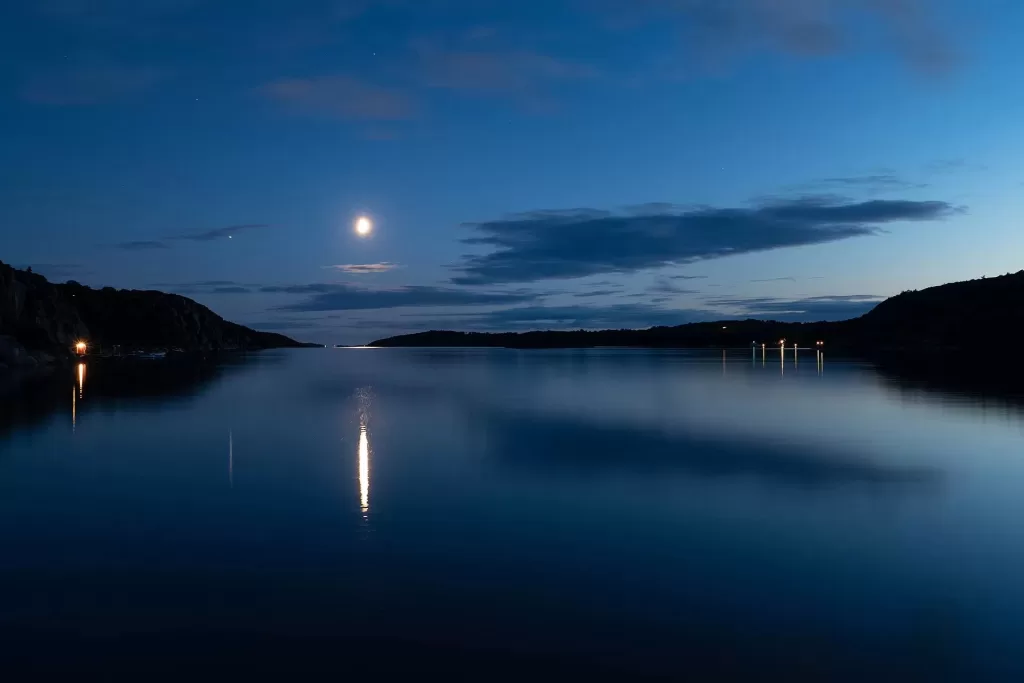
Photo: the moon over water at night. By W.carter, CC0 via Wikimedia Commons.
Source: In-The-Sky.org, conjunction and lunar occultation pages, with times calculated for the coordinates of Kuwait City.
Kuwait One, once a week.
The most useful stories we published this week, in your inbox.
No spam. Unsubscribe anytime.