Wireless charging is not one technology. It is a standard called Qi, run by the Wireless Power Consortium since 2010, and more than 13,000 products on sale today carry its certification mark.
What changed
The second version of the standard arrived in 2023. It raised power to 15 watts and added the part that actually changed the experience: a ring of magnets that pulls the handset onto the right spot over the coil. The old flat pad left you to find the centre yourself, and when you missed it the energy left as heat instead of going into the battery.
Version 2.2.1 followed in July 2025 under the commercial name Qi2 25W, with close to 70 per cent more power than the version before it. The consortium says that is enough to take a phone battery from empty to half full in roughly half an hour.
Why the magnets matter
Wireless power moves between two facing coils. The further the centre of one sits from the centre of the other, the more of the transfer is lost as heat, so charging slows and the handset warms. Magnetic alignment removes that human error: the phone settles in one position and nowhere else, efficiency rises and heat falls. The same magnets are what let wallets, stands and car mounts clip onto the back of a phone.
How to check before you pay
The Qi and Qi2 logos may only be printed on a product after it has passed testing at an independent laboratory authorised by the consortium, covering safety and interoperability with other makers’ devices. A box that simply says “25W wireless charging” is making a claim, not showing a certification. The consortium keeps a public database of certified products, so search the model name in it before you buy.
There is also a benefit that never appears on a spec sheet. Worn cables and broken charging ports are among the most common faults on a phone, and charging on a pad spares the port its daily use.
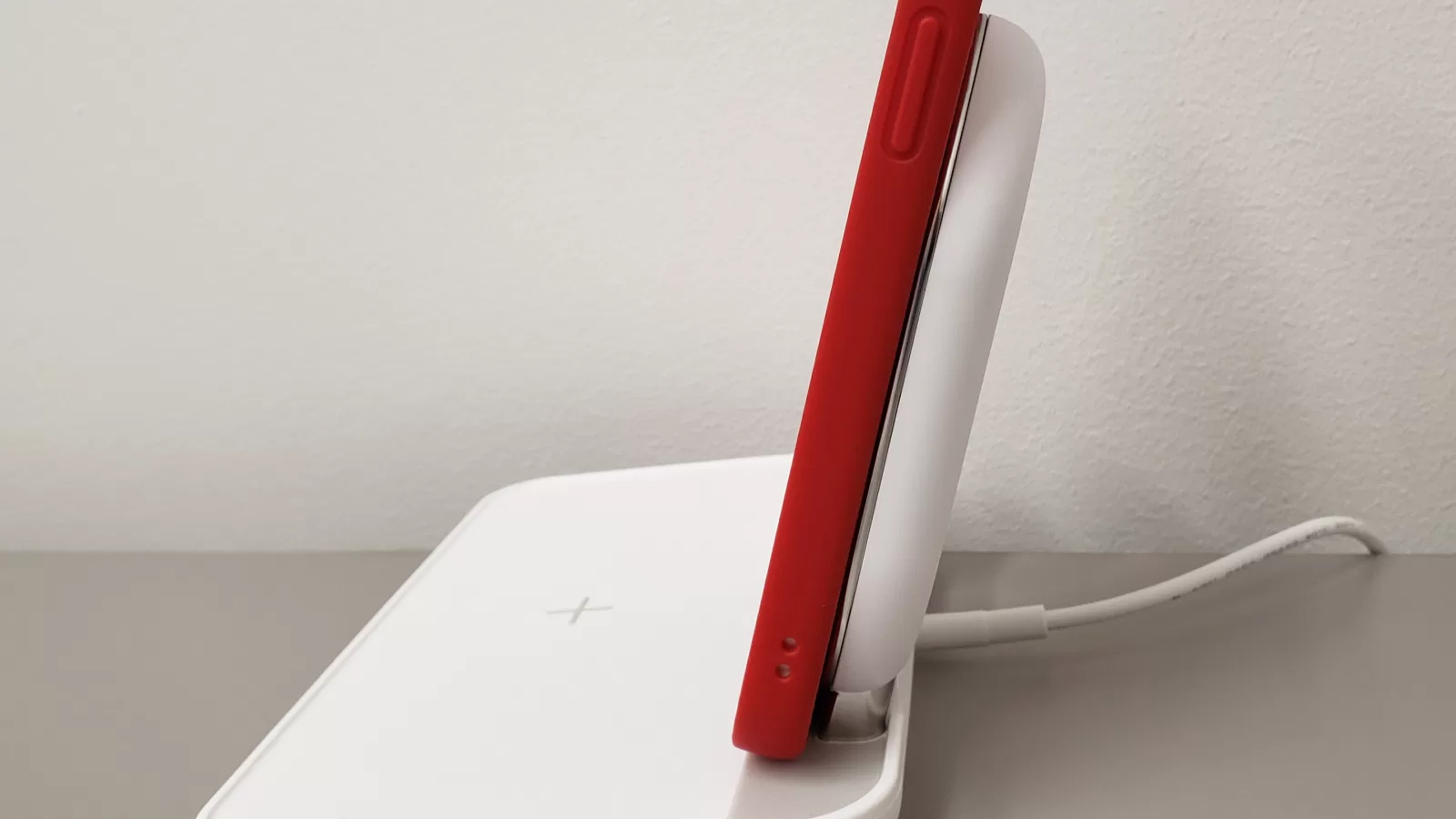
Photograph: a phone charging on a wireless stand. Photo by Wkoubnv, CC BY-SA 4.0 via Wikimedia Commons.
Source: Wireless Power Consortium, Qi standard page.
Kuwait One, once a week.
The most useful stories we published this week, in your inbox.
No spam. Unsubscribe anytime.