The Shuaib family: an island home, a Sharq waterfront and an unread telegram
Failaka boat owners who kept a town house in Kuwait, and a grandson who learned English at the mission school, then ran customs.
The Shuaib family kept two homes: the main one on Failaka Island, and a second in Kuwait Town for market days and errands. The island produced a navigator who knew the sea lanes; the town produced a young shopkeeper who learned English because a telegram sat unread in his pocket for an hour, and who went on to run Kuwait’s customs.
A house on the Sharq shore
The best-known family member in the mid-1800s was Ali Al-Shuaib, a man of means whose boats went pearl diving, fishing and on voyages to India. His town house stood on the Sharq waterfront beside the Al-Asfour house, near the old Health Department building, with the family’s own boat basin (nuqa’a) on the beach in front, close to the Al-Khamees basin. Boats tied up there before heading back to Failaka.
The house dated from the early nineteenth century and had rooms for a diwan, a store for ship’s gear, and a pen for sheep, a donkey and a cow. It passed to Ali’s son Shuaib Al-Ali, who, as the family’s fortunes turned, sold it to Ahmad Al-Farhan, a boat owner who wanted to live within sight of his moorings.
A mosque on the island, a navigator on the water
On Failaka the family had the Shuaib Mosque, where Mulla Maarouf served as imam and preacher. Another island figure, Sultan Shuaib, was a respected nakhoda (ship’s captain) known for his command of sea routes; writings on navigation are attributed to him, and the noted pilot Mansour Al-Kharji is said to have learned from him. Over time most of the family moved to the town.
The telegram nobody would read
Abdulsalam Mohammed Shuaib was born in the Sharq quarter in 1903 and learned the Quran, reading, writing and arithmetic at the school of Mulla Saad Al-Sharhan. His father died when he was young, and he grew up working in his maternal uncle’s shop.
He later told the writer Abdulfattah Al-Maliji how he came to English. At the time, he said, only one man in Kuwait could read it: Mirza Habib, a clerk at the Maarafi family’s steamship agency. One evening a telegram arrived just before closing; Mirza kept him waiting an hour and never translated it, so he took it to a doctor at the American Hospital instead. He then enrolled in the American mission’s afternoon English classes in the Qibla quarter, bought a primer in the market and memorised the alphabet before he got home. He stayed about five months and taught himself the rest, around 1923 or 1924.
From Jubail to the ministry
He was cashier at the customs post in the Saudi port of Jubail from 1935 to 1937, then head of public relations at the Kuwait Oil Company, then a trader in Bahrain until 1950. Back in Kuwait he became deputy director of the Public Health Department until 1953, later director general of customs, and finally undersecretary of the Ministry of Customs and Ports until he retired in 1962. In 1963 he joined the board of Kuwait Airways and became vice-chairman under Nisf Al-Yousef Al-Nisf. Customs staff remembered him above all for insisting on punctual hours. He died in Lebanon in 1973 and was buried in Kuwait.
The next generation
His son Mohammed, born on Failaka in 1924, studied at the Hamada and Mubarakiya schools, taught at the Ahmadiya school, then went into trade in 1947 and sat on the board of the Chamber of Commerce. Hamed, born in 1933, studied architecture in Oxford and urban design in Liverpool and rose to chief engineer at Kuwait Municipality. A third son, Nouri, served in the diplomatic corps and became an ambassador.
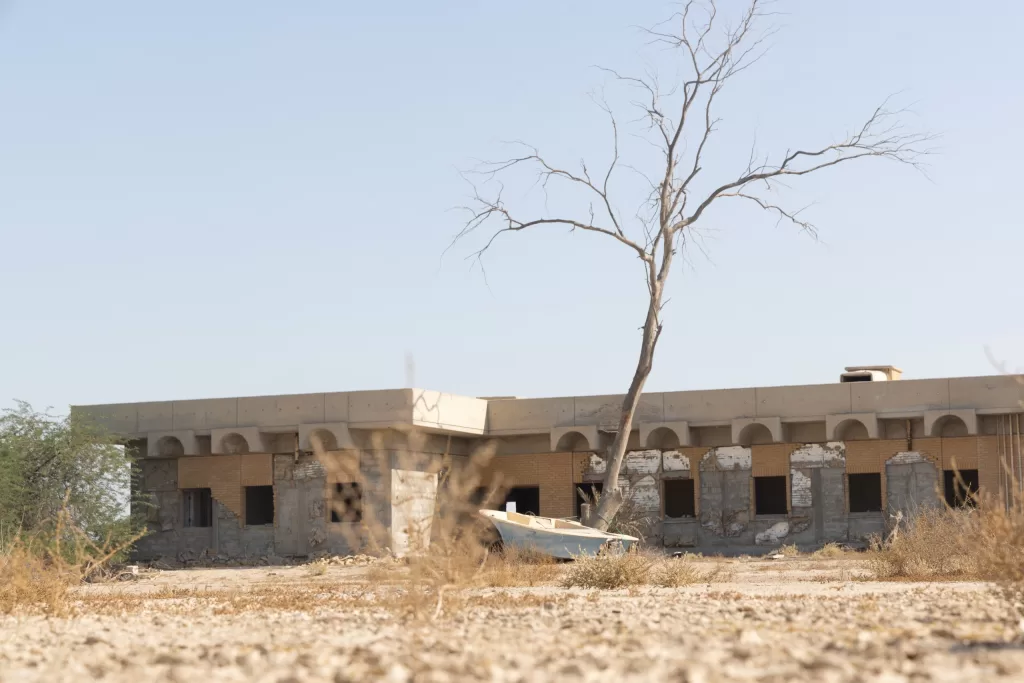
Photo: an abandoned building and a beached boat on Failaka Island today. Di7ane, CC BY-SA 4.0, via Wikimedia Commons. The building is modern and unconnected to the family; the picture shows the island they came from.
Source: Farhan Al-Farhan, “The Al-Shuaib in Kuwait Town and Failaka” (2002), reproduced on the Kuwait History forum, quoting Abdulfattah Al-Maliji’s Men and History and Hamad Al-Saidan’s Kuwaiti Encyclopaedia; Dr Yacoub Yousef Al-Ghunaim, “Min Ahliha (1)”, Al-Nahar, 6 January 2019.
Kuwait One, once a week.
The most useful stories we published this week, in your inbox.
No spam. Unsubscribe anytime.