Kuwait has an old habit of naming a year after what happened in it. The year of the plague, the year of the hailaq, the year of the flood. Ibrahim Al-Khalidi’s book Sanawat Al-Kuwait records forty-three named years across roughly four centuries, from the plague year of 1733 to the pandemic years. One of them is the year of the bishts.
What happened
In mid-January 1930 Sheikh Ahmad Al-Jaber Al-Sabah ordered that no one in the country wear the bisht, the men’s cloak. The historian Dr Yaqoub Yusuf Al-Ghunaim gives the date as 15 January; Ali Ghuloum Al-Rais’s book on the ruler gives 14 January and says the order covered the bakura cane and the diqla as well. Some accounts place the whole episode in 1931. We record the disagreement rather than settle it.
Two reasons are given together: an economic one, after the collapse of the pearl market, and a social one. Abdullah Al-Hatem writes that a cloak cost a great deal, and that a poor man owned one abaya and wore it heavy in high summer or thin in the cold, because it was all he had.
Who complied and who resisted
Hamad Al-Rujaib’s memoirs name names. Sultan Aman never wore it again. Sheikh Yusuf bin Issa Al-Qinaie replaced it with a jubba over the qaftan, in the manner of Al-Azhar scholars. Sheikh Abdullah Al-Jaber appeared at Seif Palace in a diqla with a cane, keeping the ghutra and the iqal. A class of men stopped wearing it and carried it under the arm instead.
Enforcement then turned violent. Zealous young men went after those still wearing the cloak and cut it from behind with a knife, until the ruler had to forbid the harassment publicly and make the matter voluntary.
Why the order was withdrawn
Hamad Al-Saidan explains that the ban fell a month before Eid al-Fitr, in late Shaaban 1348 AH, and the winter was cold. People had nothing to wear for the feast, so they stayed home. That is why the order was reversed. No written text of the order itself has survived, and no document rescinding it; everything we have is memoirs and historians retelling them.
The verse that kept the name
The episode survives in a poem by Ibrahim Al-Khaled Al-Deehani, quoted in full by Al-Ghunaim, which opens with the news that the cloak was to be cast off and which contains the line later read as a comment on an entire era: a new age, and we have only just entered it.
The cloak itself
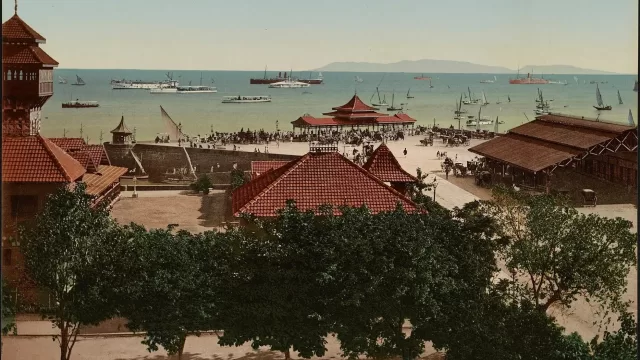
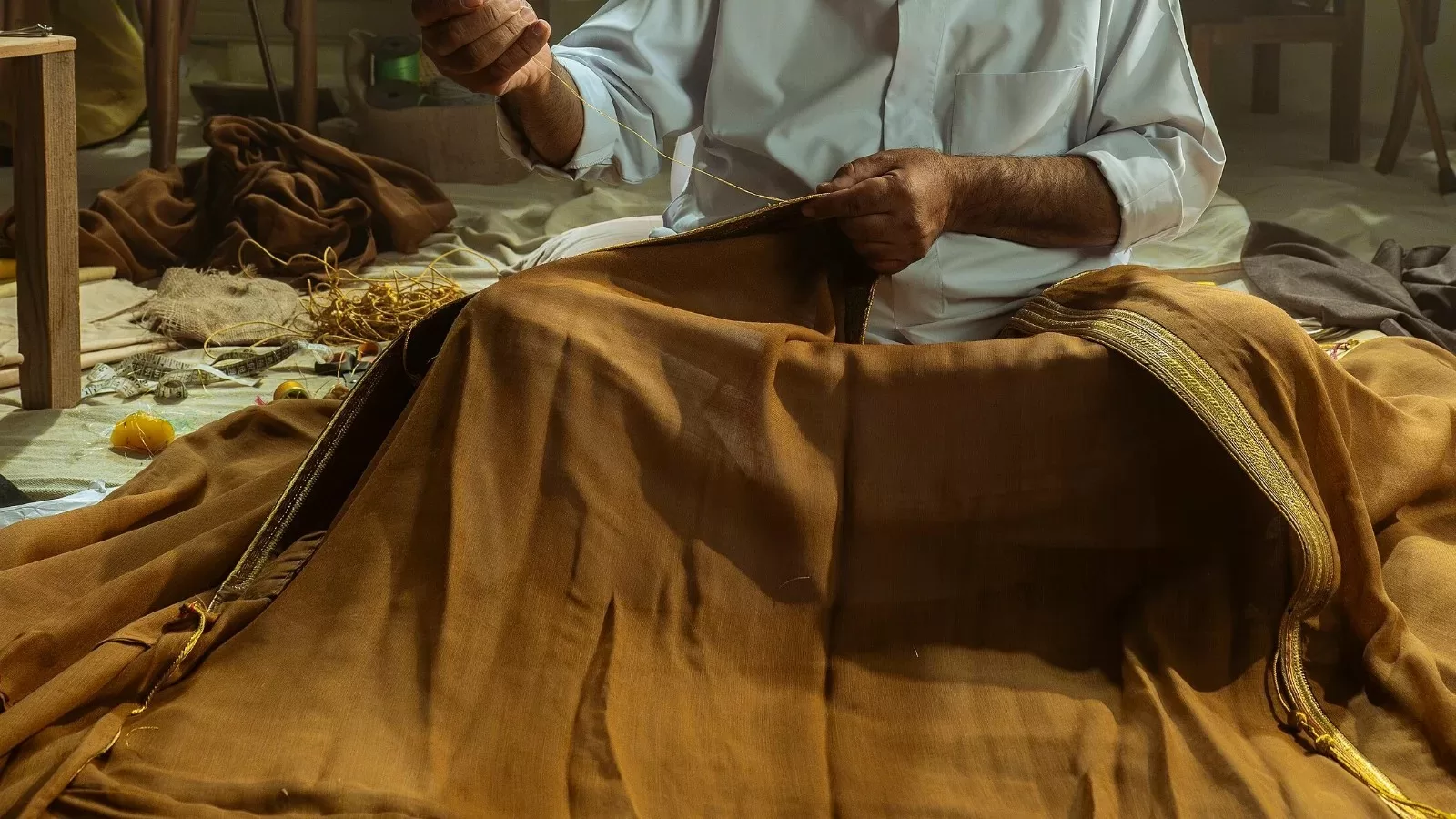
The bisht market sat inside the carpet souq near the Grand Souq mosque in Mubarakiya. The tailors brought their cloth from Syria and Iraq, sat on the ground cutting and stitching in full view, and trimmed the edges with braided gold ribbon. The carpet souq was later demolished and Sheikh Fahad Al-Salem’s qaysariya built on the site.
The types are named for places: the Hasawi from Al-Ahsa is the best known, the Najafi the finest, lightest and dearest, and there are the Sharja and Nizwani besides. Turathona magazine lists some thirty-seven Kuwaiti merchants who made and sold cloaks between 1904 and 1918, among them Abdulrahman Al-Houti, Abdullatif Al-Houti, Mohammad Al-Saleh Al-Ateeqi, Saif Al-Ateeqi and Abdulaziz Al-Rasheed.
And today
The trade is still alive among Kuwaiti makers. A Najafi starts at 500 dinars and is the most in demand; a Kashmiri passes 5,000; an Iraqi Muqri runs from 1,500 to 6,000 and is stitched thread by thread over more than four months. The entry level begins at 70 dinars. Those are 2023 prices. What a bisht cost in 1930 we do not know, because the sources do not say.
Photo: hand-sewing the Hasawi mishlah. From the Saudi Press Agency, CC BY-SA 4.0 via Wikimedia Commons, cropped.
Sources: Dr Yaqoub Yusuf Al-Ghunaim in Al-Anba, 29 November 2021; Ali Ghuloum Al-Rais’s book on Sheikh Ahmad Al-Jaber as serialised in Al-Rai, 30 October 2025; Turathona magazine, 27 April 2022; and Al-Jarida on the book Sanawat Al-Kuwait, 24 December 2021.
Kuwait One, once a week.
The most useful stories we published this week, in your inbox.
No spam. Unsubscribe anytime.