Clarified Butter: It Is the Water That Leaves, Not the Solids That Are Strained
The share drops from about sixteen per cent in butter to under half a per cent, and nothing is left for a microbe to live in.
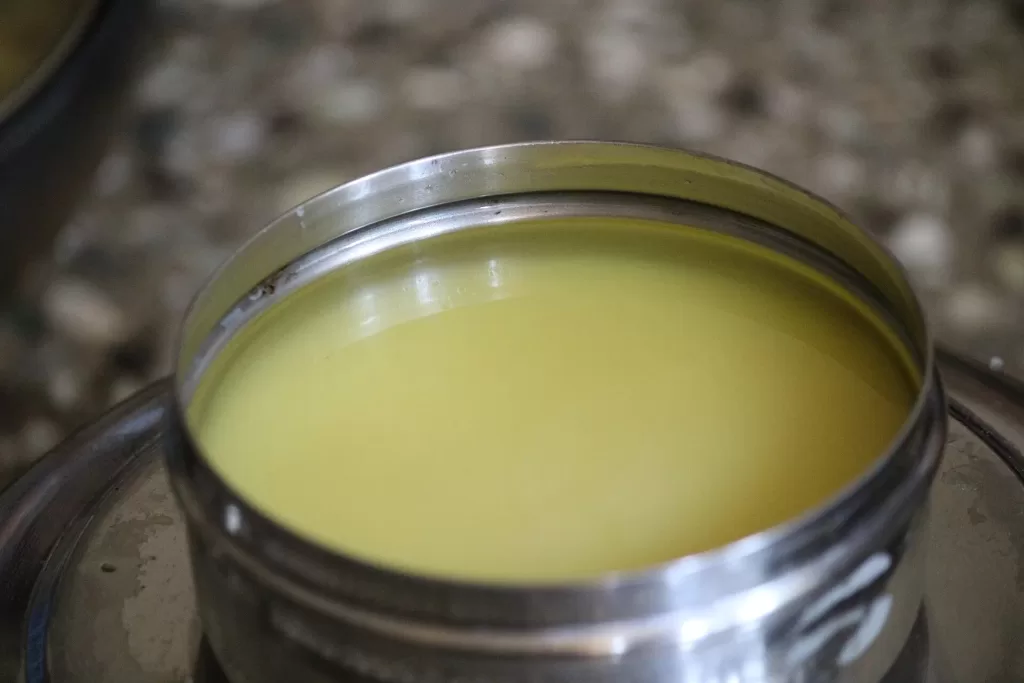
Ghee is often described as strained butter, and the description is incomplete. What happens in the pan is not straining but the removal of water. Butter is a compound of eighty to eighty-two per cent fat and sixteen to seventeen and a half per cent water. In ghee, less than half a per cent of that water remains.
Why it keeps without a fridge
The Food and Agriculture Organization puts it plainly: its advantage over butter comes from the near-complete removal of water during manufacture. Boiling drives the moisture below one per cent, which prevents microbial growth and at the same time kills spoilage bacteria and pathogens.
The general rule in food science is that most foods have a water activity above 0.95 — enough moisture for bacteria, yeasts and mould. Fat has no water in it at all.
The sign a cook knows
The temperature is around 110 to 120°C with constant stirring over a low flame. The practical proof it is done is a second foaming: the first is the water leaving, then it settles, then a much finer foam appears as the curd granules brown. That is the moment the flavour is created — and also the moment the temperature suddenly jumps, so the heat has to be managed.
The flavour is made, not found
The characteristic flavour is not in the butter before heating. It is the product of a heat reaction between protein, lactose, fat and minerals over ten to twenty minutes at that temperature.
How it spoils
Ghee does not go mouldy; it goes rancid. The enemy is oxidation rather than bacteria, driven by unsaturated fatty acids. Copper accelerates it: the international standard caps copper at 0.05mg per kilogram and iron at 0.2, and the Swiss research station describes the resulting taste as metallic or tallowy, and in severe cases fishy.
Against that, it carries its own protection: beta-carotene and vitamin E. Its smoke point is around 250°C, well above butter, which smokes between 140 and 180.
In the Kuwaiti house
The vessel has a name: the bastooq, also called the mutabbaq, of pottery or metal — people said “the ghee bastooq”. To pour it from one vessel to another there was the mihqan, the funnel, sold in copper at the coppersmiths’ souq. And the girba, of goat or cow hide, kept ghee and buttermilk the way it kept and cooled water.
It was used at the table when serving rather than in the pan: hareis has fine sugar, local ghee and ground cinnamon added as it is served. Batheeth and khabees are made from flour, dates and ghee.
What we cannot say
The temperatures and times above are general figures from ghee manufacture, not a documented Kuwaiti recipe. And we found no source giving how long the ghee in a Kuwaiti house stayed good, so there is no number here.
Photo: clarified butter in a metal tin. By Phadke09, CC BY-SA 4.0 via Wikimedia Commons.
Source: the FAO on traditional milk product technology, the Codex standard for milk fat products, the Wisconsin Center for Dairy Research, the US Food and Drug Administration on water activity, the Swiss Agroscope station, and the “Dreesha Turathiya” series in Al Qabas, Al Rai and Al Jarida.
Kuwait One, once a week.
The most useful stories we published this week, in your inbox.
No spam. Unsubscribe anytime.