Chraimba and the Omani Fold: Every Way of Wearing the Ghutra Had a Name
The Najafi bisht is woven by hand from sheep's wool, and the Dawraki comes from Iran and is prized for being light.
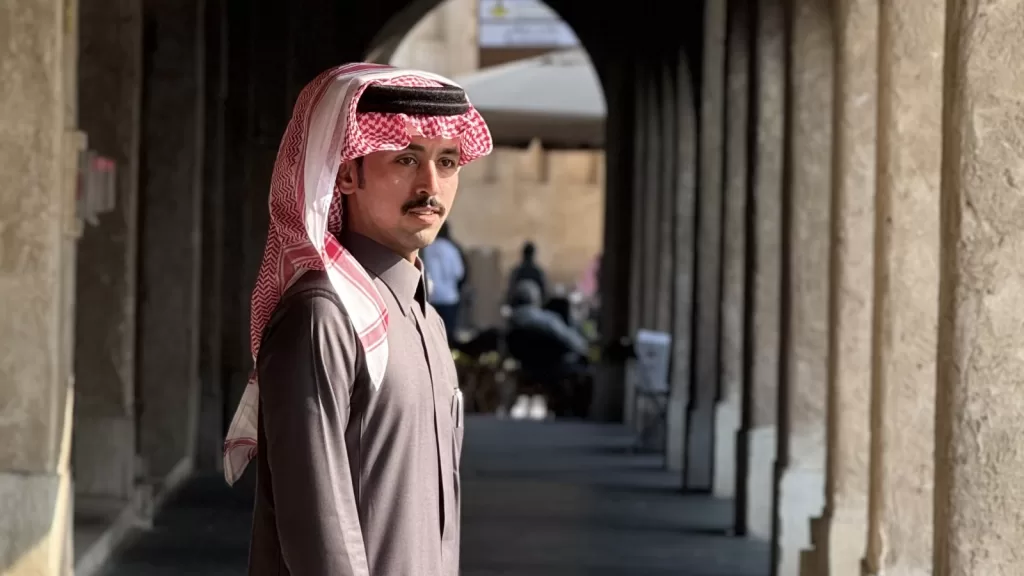
Fashion is not a thing of today. Old Kuwaiti society followed fashion in dress as it did in everything else, until even the way a ghutra was set on the head had a name of its own.
The ghutra and the nasfa
Some set it on the shoulder, ironed and arranged; some let it hang down either side of the head; some threw it on with no arrangement at all. That last is called “chraimba”.
And there is the “Omani nasfa”: folding the ghutra in half and wearing it folded.
The shmagh was worn in winter, then came to be worn in summer and winter alike, and in its early days was more of the desert than the town.
The dishdasha and the ghoula
The shape of the dishdasha changed until it showed the line of the body, and was then called “mukhassara”, waisted. It had a collar called the “ghoula” that hung down either side of the neck, until the ghoula came to wrap round the neck with one or two buttons set in it as the wearer preferred.
The bisht: six kinds
Over the dishdasha goes the shilah or bisht, cut to the body, its front embroidered with gold and silver thread. The higher the wearer’s standing, the costlier the weave.
- Najafi — woven by hand from sheep’s wool.
- Dawraki — brought from Iran, also hand-woven from sheep’s wool, and prized for its light weight.
- Mahoud, darbouya, nusf darbouya, and mazwiya.
The robe of the notables
The “digla” is a robe resembling the dishdasha, with two openings at the sides, hanging below the knees, closed at the chest with buttons or a clasp called a “chilab”. It was worn by men of standing.
They also wore the gumsala and the sideiri, and older men kept a watch in its upper pocket on a chain hanging across the chest. The jacket was called the “balto”, reaching mid-abdomen; longer, to below the knees, it became a “barkoot”.
The igal
The “igal maraz” was made from goat’s wool and was black, though some wore white. There is the “bushtafa”, also called muqassab, and the “igal zari” worn on occasions.
What is not seen
The underclothes had their names too: the “captain” vest with a ship’s propeller printed on it, the “umm allaq” vest also called muzallata, and the vest with openings called “mukharrama” or umgadhadha, its openings there to air the body in the heat of the summer.
Below, there was the “wizar”, then underwear proper: the “half” above the knee, then the shorter “slip”. Over it went long trousers reaching above the feet, called “khirri” or mukassar.
Photograph: a red ghutra and black agal as worn today. By Di7ane, CC BY-SA 4.0 via Wikimedia Commons.
Source: Al Qabas, the “Dreesha Turathiya” series by Dr Saud Mohammad Al Osfour, “The dress of the Kuwaiti man in the past”.
Kuwait One, once a week.
The most useful stories we published this week, in your inbox.
No spam. Unsubscribe anytime.