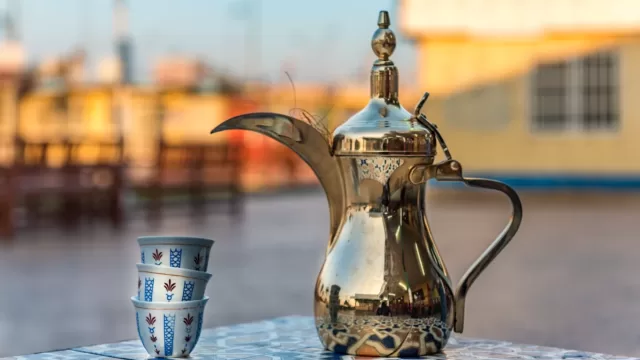

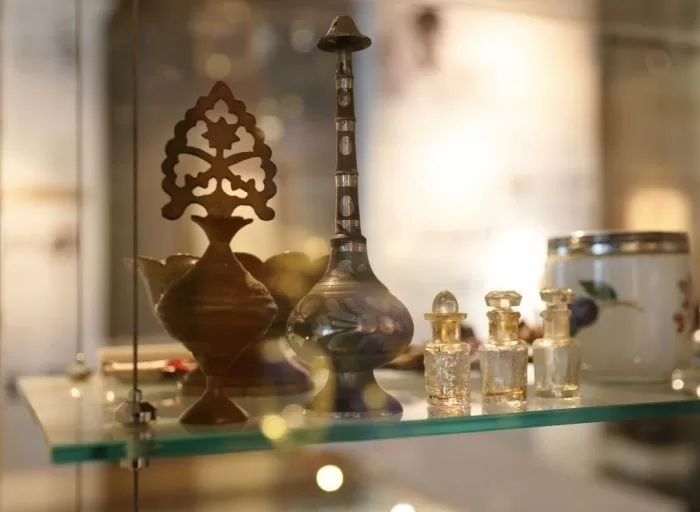
In a time when everything moved more slowly, Kuwaiti women assembled how they looked and smelled out of what was around them rather than out of imported bottles. Kohl, scent and bakhoor were not simply cosmetics but daily practices with rules of their own.
Kohl
From childhood a Kuwaiti girl learned that kohl was not only decoration. It was prepared at home from ithmid stone, roasted over a fire and then ground fine, and kept in a small silver or copper pot, the mikhala. It was worn day to day, and particularly at Eid, at weddings, or when a woman went out to a women’s diwaniya or on visits.
It was also believed to have medical benefits: that it protected the eye from irritation and dust and cleared it, an effect recorded in traditional remedies. And the kohl-lined eye became a figure in Kuwaiti poetry, in songs and in proverbs.
Scent
“A good scent is not forgotten.” Perfume was part of a woman’s presence, and often the first thing noticed when she entered a gathering. Scents were not bought for the smell alone but for the character they carried. Oud oil, musk, rose and amber were the common ones, blended by hand in some households to recipes passed between women.
A woman would mix oud oil with a little white musk and keep the blend in a small bottle, applying it behind the ears or to the ends of the hair before going out. On some occasions she put it along the edge of the daraa, so the trace stayed as she greeted people and sat down.
And a good scent was taken as evidence of good upbringing and care. So mothers taught daughters early how to wear perfume with restraint rather than simply applying it.
Bakhoor
Incense was a daily practice, and hardly a day passed without it being lit. After cleaning, after lunch, or in preparation for the evening, a woman lit her burner and put in pieces of aged oud, or ready blends known by names such as saifi, malaki or shuyoukhi. The burner was carried around the corners of the house, under clothes, or passed through the hair, in a practice called tabakhkhur.
Bakhoor was kept in dedicated boxes, some carved or decorated, and given as a gift at weddings and occasions. Women’s gatherings did not begin until the burner had been passed to each guest in turn.
In a period when synthetic scents were not widespread, bakhoor was the character of the house. Anyone who knew a woman knew her bakhoor, and every household had its own smell.
Then and now
These practices still live in many houses, whether through the memory of grandmothers or through a return to traditional oud and kohl at particular occasions. And there is an irony in it: many international perfume houses have lately turned back toward the oriental notes Kuwaiti women were blending decades ago.
At some weddings today traditional perfume is given as a gift, and a bride is provided with boxes of bakhoor and fine oud oil. And some young women are learning to make a personal scent blend, exactly as their mothers did.
Further reading: the National Council for Culture, Arts and Letters · the Center for Research and Studies on Kuwait
Kuwait One, once a week.
The most useful stories we published this week, in your inbox.
No spam. Unsubscribe anytime.