
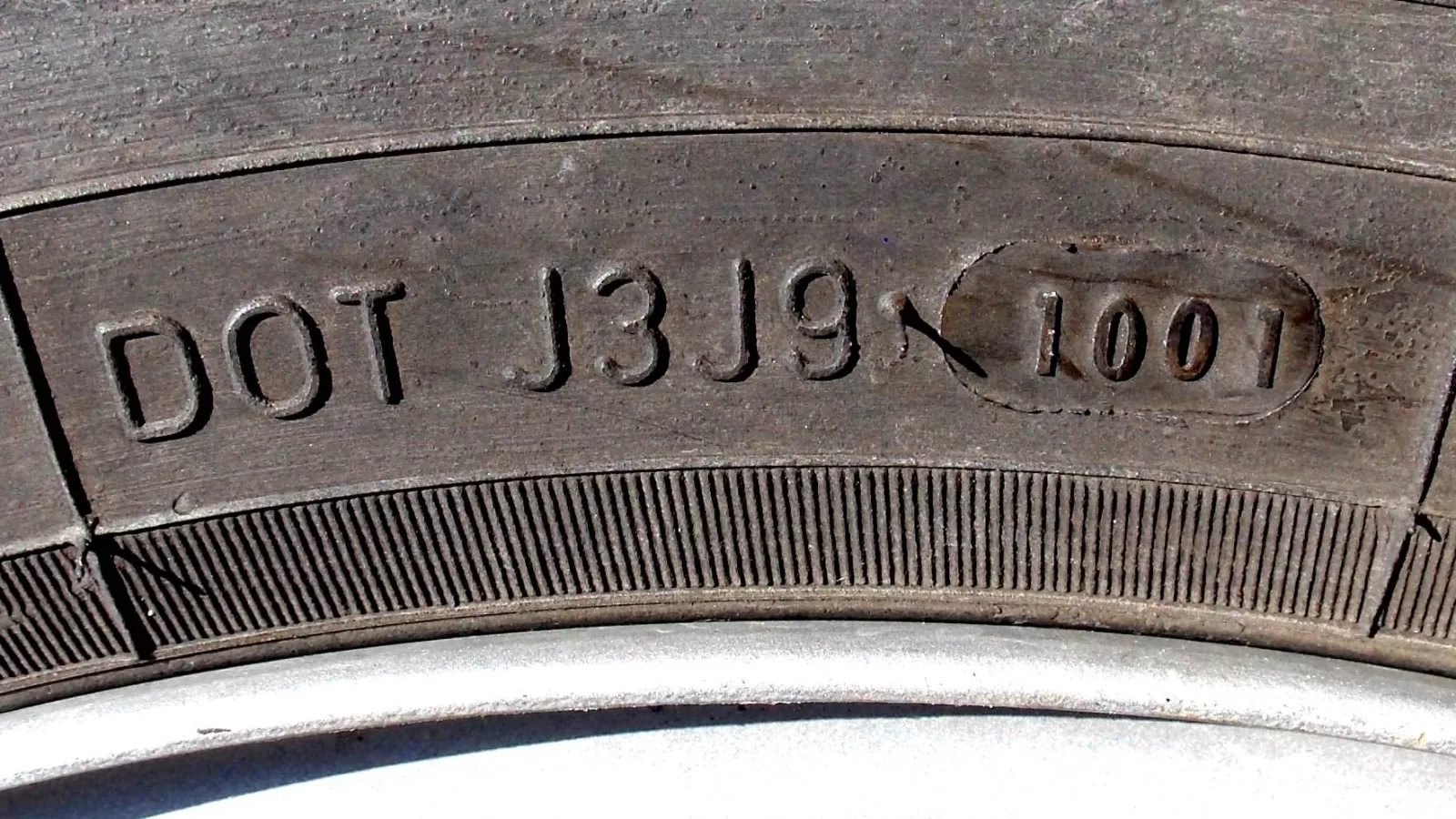
A tyre fresh off the rack is not necessarily new. It may have been built five years ago and sat in a warehouse since. The sidewall will tell you, once you know where to look.
Step one: find the word DOT
Somewhere on the sidewall is the word DOT followed by a run of letters and digits. Check the outer face first; if it is not there, check the inner face, because some plants stamp the full number on one side only.
Step two: read the last four digits
The final four digits, usually inside an oval, are the build date: two for the week of the year, two for the year. A tyre reading 0308 was made in the third week of 2008; one reading 1001 was made in the tenth week of 2001.
If you find three digits instead of four, the tyre predates 2000. Do not fit it.
Step three: compare the age
NHTSA notes that some vehicle and tyre manufacturers recommend replacing tyres at six to ten years old regardless of how much tread is left. Rubber ages under heat and sun, which means a tyre in Kuwait is not living the life of a tyre in a cold climate.
Step four: the spare counts
The spare in the boot has never turned on a road, but it ages like everything else. Read its code too.
Two quick checks while you are down there
- Tread depth. A tyre is unsafe and should be replaced once the tread is worn to 2/32 of an inch, roughly 1.6 mm. Small raised bars sit in the grooves at exactly that depth.
- Pressure. The correct figure is on the label at the driver’s door edge or in the owner’s manual, not on the tyre. The number moulded into the sidewall is the maximum, not the recommendation.
Photograph: a DOT stamp moulded into a tyre sidewall, its last four digits giving the build date. Public domain file via Wikimedia Commons.
Source: the tyres page of the National Highway Traffic Safety Administration.
Kuwait One, once a week.
The most useful stories we published this week, in your inbox.
No spam. Unsubscribe anytime.