Yiqit: The Spring Paste You Judge by Its Colour and Its Smoothness
Very white and very smooth is suspect, and anything appearing out of season is more suspect still.
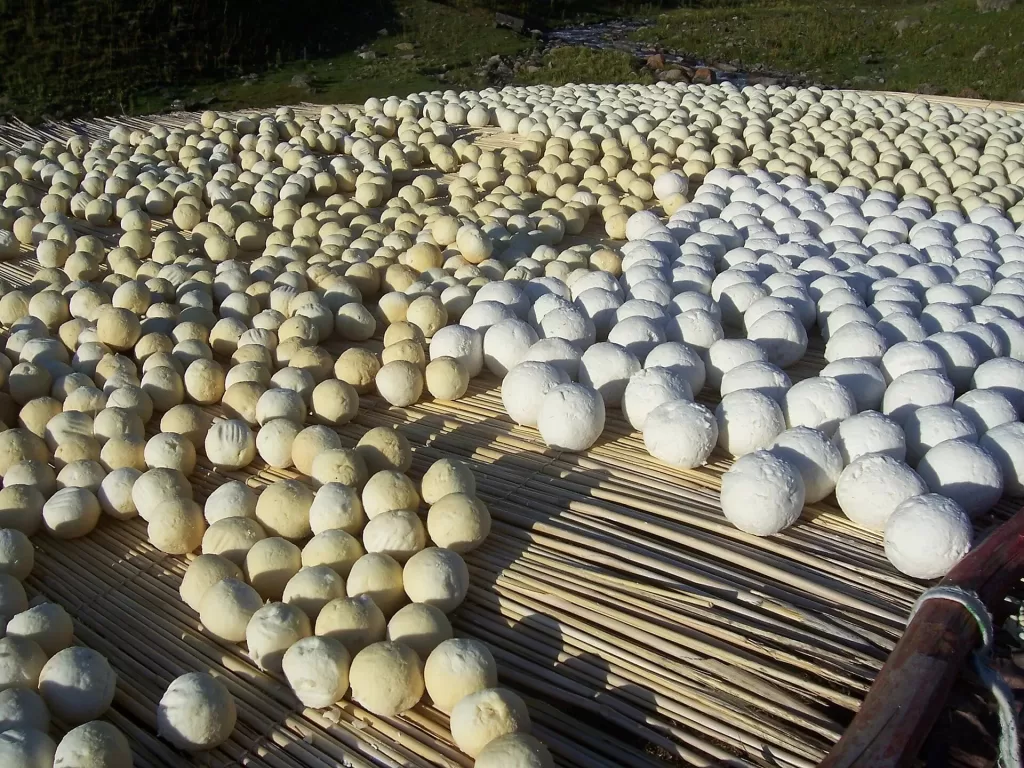
“Yiqit” in town speech, “iqit” in standard Arabic and in bedouin speech. One product, two names, and between them an old road running from the desert to the town in Kuwait. It is sheep’s milk with the water taken out of it, left as a block that keeps for months.
Why spring
Yiqit belongs to one season: spring. The rain falls, the grass comes up, the sheep give more milk. And when the milk is more than can be drunk it is turned into something that keeps. The product is not a choice but the result of a seasonal abundance that does not last.
The method
- The milk is left until it takes on the necessary acidity, sometimes with a little salt added.
- It goes into a pot over a low flame until it curdles.
- The remaining liquid is separated off.
- The curd goes back over a low flame with a little stirring, for fear of catching.
- When it becomes a paste it is cut and pressed, leaving the marks of the fingers on the piece — as a shape, and as a fineness or a roughness.
How the experienced spot the adulterated
The known adulteration is to replace fresh sheep’s milk with powdered milk. Two signs of it in the market:
- Very white and very smooth — the smoother and whiter it is, the more doubtful.
- Being there out of season — appearing far from spring means it was made long ago, and the colour says so.
The Persian kind is not the same
Iranian yiqit differs in shape and taste: small round balls, saltier, hard and softening after a bite. The Arabian desert version is pieces pressed by hand.
Where it is sold, and what it is mixed with
It is usually sold by the sellers of dihn adani, because the season is the same. It is sold by measure, and the price follows trust in whoever made it rather than the weight alone.
From yiqit comes a mixture called shaatha: it is ground and kneaded with dates and dihn adani, sometimes with cardamom or nuts added, then shaped into small balls or served in a dish.
Photo: balls of dried milk curd set out to dry. By Paul Munhoven, CC BY-SA 3.0 via Wikimedia Commons.
Source: Dr Saud Mohammad Al Osfour, “Dreesha Turathiya: yiqit (iqit) past and present in Kuwait”, Al Qabas, 20 August 2020.
Kuwait One, once a week.
The most useful stories we published this week, in your inbox.
No spam. Unsubscribe anytime.